Goals and architecture#
Goals#
Share processed data in a well-defined, stable data structure so that every application starts from the same network, trajectories and signal timing;
provide the common utilities (loading, filtering, aggregation, plotting) that research applications need, so that they are written once;
avoid duplicated development on raw data pre-processing, which is expensive and error-prone;
make quality control and long-term maintenance possible through a documented pipeline whose intermediate results can be inspected.
Architecture#
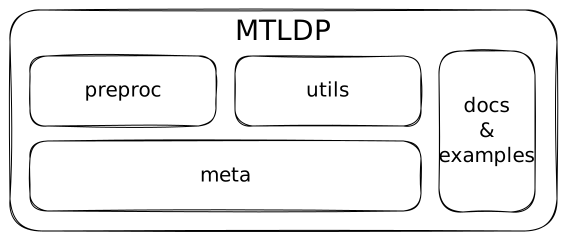
The architecture of MTLDP.#
MTLDP is layered. mtldp.meta defines the data structures, mtldp.utils provides the
functions that work on them, and mtldp.preproc produces them from raw data. Applications and
the data production pipelines are built on top of these three packages and never touch raw data
directly.
Repository |
Content |
|---|---|
|
|
|
|
|
Web tool to review the network built for a region and record corrections. |
|
This documentation and the example notebooks. |
Research applications |
Signal diagnosis and optimisation, traffic models (for example the OSaaS paper model), network analysis; each in its own repository. |
Data production |
Offline and real-time pipelines ( |
Two workflows#

Data production: raw map, trajectory and SPaT data are processed once into the standard data structures.#

Research applications: processed data is loaded through AppRegion and analysed with the
utilities, without touching raw data.#
The unit of work in both workflows is the region, a bounding box with one configuration file and two data directories. Large regions are tiled into sub-regions that are processed independently; Regions and sub-regions describes this design.